
BRANDKETT offers powerful growth opportunities, but understanding pricing models is essential before investing your budget. One of the most common questions marketers ask is: What is the difference between CPC, CPM, and CPA?
If you are running ads on platforms like Google Ads or Meta Ads, choosing the right bidding model can directly impact your ROI.
Experience: Why Understanding CPC, CPM, and CPA Matters
From real-world campaign management experience, one common mistake businesses make is selecting the wrong pricing model for their goal.
For example:
- A brand wanting traffic chooses CPA.
- A company wanting sales runs only CPM.
- A startup with limited budget selects high-cost CPC keywords.
This mismatch leads to wasted ad spend.
Understanding the difference between CPC, CPM, and CPA helps you:
- Control advertising costs
- Align campaigns with goals
- Improve conversion rates
- Maximize return on investment
Now, let’s break down each model clearly.
Expertise: What Is CPC?
1. CPC (Cost Per Click)
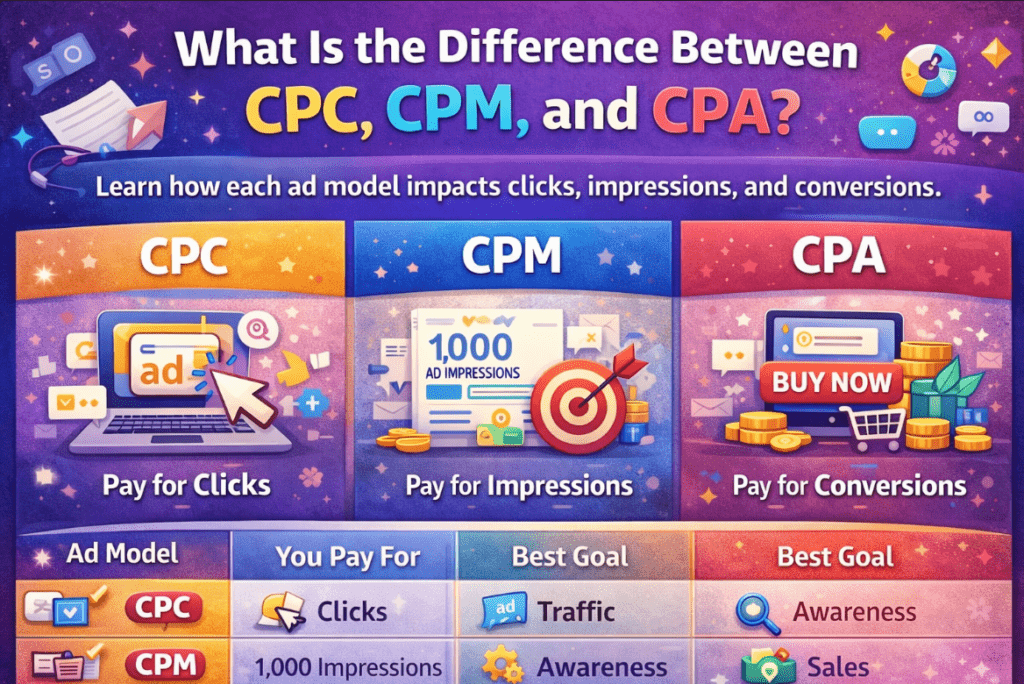
CPC means you pay every time someone clicks on your advertisement.
If your CPC is ₹10 and you get 100 clicks, you pay ₹1,000.
Best Used For:
- Website traffic
- Lead generation
- Blog promotion
- Landing page visits
Advantages:
- You only pay for engagement.
- Easier to measure traffic performance.
- Great for startups testing campaigns.
Disadvantages:
- Clicks do not guarantee conversions.
- Competitive keywords can increase costs.
CPC works best when your landing page is optimized for conversions.
Expertise: What Is CPM?
2. CPM (Cost Per Mille / Cost Per 1,000 Impressions)
CPM means you pay for every 1,000 times your ad is shown, regardless of clicks.
If your CPM is ₹200, you pay ₹200 every time your ad receives 1,000 impressions.
Best Used For:
- Brand awareness
- Product launches
- Large audience exposure
- Display advertising
Advantages:
- Builds brand visibility quickly.
- Ideal for new businesses entering the market.
- Lower cost compared to CPC in some industries.
Disadvantages:
- No guarantee of engagement.
- Harder to measure direct ROI.
CPM is most effective when your goal is recognition rather than immediate sales.
Expertise: What Is CPA?
3. CPA (Cost Per Acquisition or Cost Per Action)
CPA means you pay only when a specific action is completed, such as:
- Purchase
- Sign-up
- Download
- Form submission
If your CPA is ₹500, you only pay ₹500 when a customer converts.
Best Used For:
- E-commerce sales
- App installs
- Subscription models
- Performance marketing campaigns
Advantages:
- Performance-based pricing.
- Lower risk for advertisers.
- Clear ROI measurement.
Disadvantages:
- Requires optimized funnels.
- Platforms may charge higher rates.
- Needs accurate tracking setup.
CPA is ideal for businesses focused strictly on measurable outcomes.
Authoritativeness: Direct Comparison of CPC, CPM, and CPA
Here is a simplified comparison to understand the difference
| Model | You Pay For | Best Goal | Risk Level |
|---|---|---|---|
| CPC | Click | Traffic | Medium |
| CPM | 1,000 Impressions | Awareness | Low |
| CPA | Conversion | Sales | Low (Performance-Based) |
Each model serves a different purpose.
There is no “best” option — only the right option for your goal.
Trustworthiness: How to Choose the Right Model
To build long-term advertising success, follow this framework:
Step 1: Define Your Goal
- Awareness → CPM
- Traffic → CPC
- Sales → CPA
Step 2: Analyze Budget
Startups with limited budgets may begin with CPC to test engagement.
Step 3: Optimize Tracking
Without proper tracking:
- CPA cannot work effectively.
- CPC performance cannot be measured.
- CPM impact cannot be analyzed.
Step 4: Test and Scale
Professional advertisers often test all three models before scaling.
Real-World Example
Suppose you launch an online clothing store.
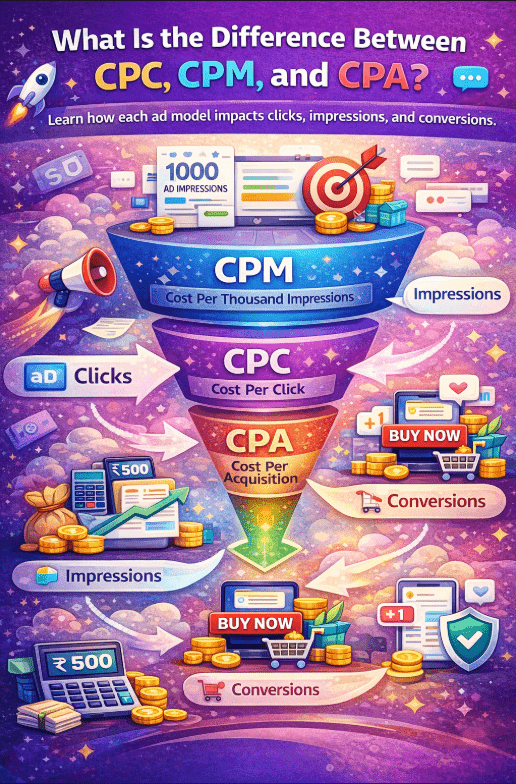
- Use CPM to create brand awareness.
- Use CPC to drive traffic to product pages.
- Use CPA retargeting ads to convert visitors into buyers.
This combined strategy reduces risk and improves efficiency.
Final Thoughts
So, what’s the difference:-
- CPC focuses on clicks.
- CPM focuses on impressions.
- CPA focuses on conversions.
Choosing the correct model depends entirely on your business objective.
When used strategically, CPC, CPM, and CPA can work together to create a powerful digital advertising system that drives sustainable growth.
If you are running performance campaigns, understanding the difference — it is essential.
5 Image Concepts for Your Blog
Below are five custom-designed image ideas for your article:
- Infographic Comparison Chart – CPC vs CPM vs CPA side-by-side explanation.
- Marketing Funnel Visual – Showing CPM at top, CPC in middle, CPA at bottom.
- Ad Dashboard Mockup – Performance metrics showing clicks, impressions, conversions.
- Cost Calculation Illustration – Example showing cost breakdown of each model.
- Digital Growth Concept Image – Business growth graph with CPC, CPM, CPA